

Goodbye, Old Friend
Symbolism and Storytelling in Anakin and Obi-Wan’s Final Parting as Friends

Note: This article may contain affiliate links, meaning we may earn a commission if you purchase through them at no extra cost to you. See our disclaimers for more information.
Among a great many other things, George Lucas is a visual storyteller. In an unused clip from a documentary later cited in Wired, Lucas shared how he “started out doing visual films — tone poems — and I move very much in that direction. I still have actors doing their bit, and there’s still dialogue giving you key information. But if you don’t have that information, it still works.”1
It’s no surprise then that Star Wars — his best-known work — is so rich in visual storytelling. “The Star Wars movies are, in essence, silent movies because they are stories that are told visually,” Lucas once said.2
Perhaps the best example is in many fans’ favorite film in the franchise (and many readers’ favorite novelization), Revenge of the Sith.
One scene in particular stands out as especially rich in symbolism and metaphor: After rescuing the (seemingly) kidnapped Supreme Chancellor, Anakin Skywalker and Obi-Wan Kenobi prepare to head off on different assignments. The two have grown together through a long and, at times, torturous journey since their meeting on Tatooine, and over the course of the Clone Wars, they have become living legends. As Matthew Stover says in his novelization: “Though it is the end of the age of heroes, it has saved its best for last.”3
Visual Storytelling
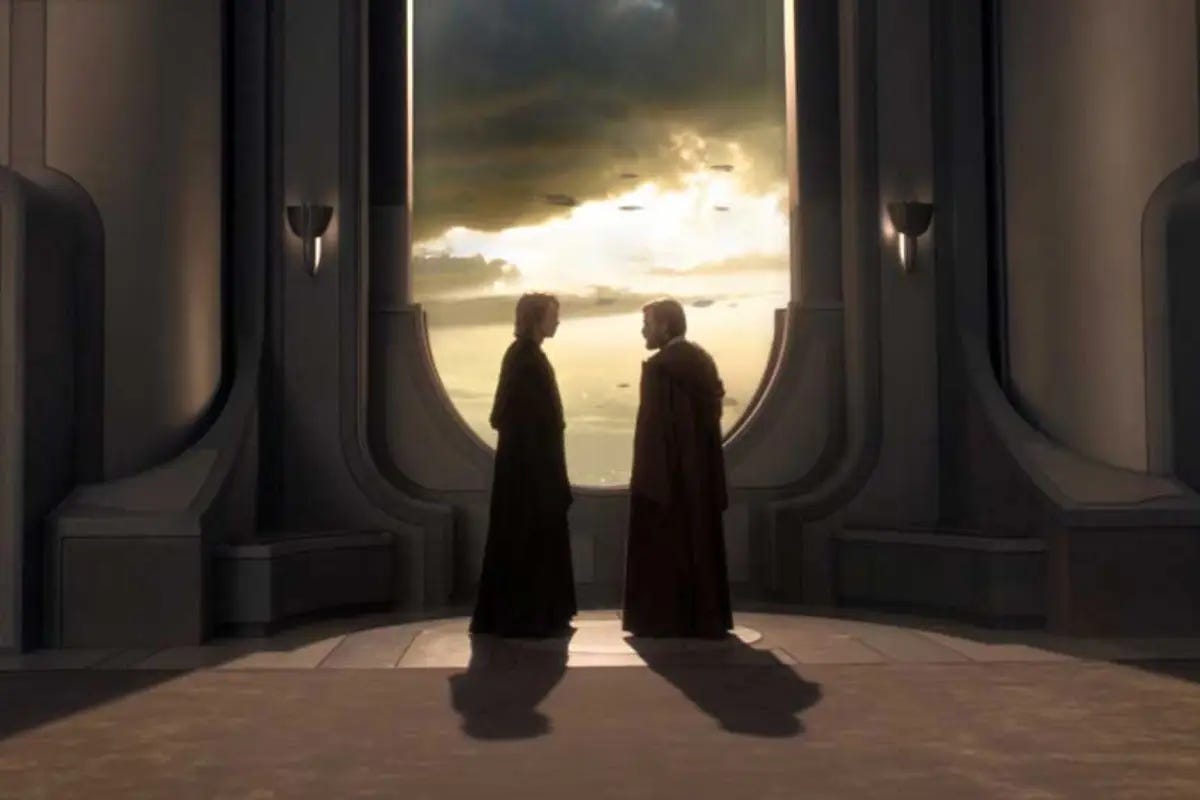
Lucas often frames and lights his shots in a way that clues us in to what’s going on. In this scene, the framing and lighting telegraph the two men’s fates. Walking down a corridor toward a waiting ship, bright light streams through the windows and casts stark shadows.
Obi-Wan, not at all coincidentally, walks in the light. Anakin walks in shadow, mirroring his past struggles and suggesting his future path.
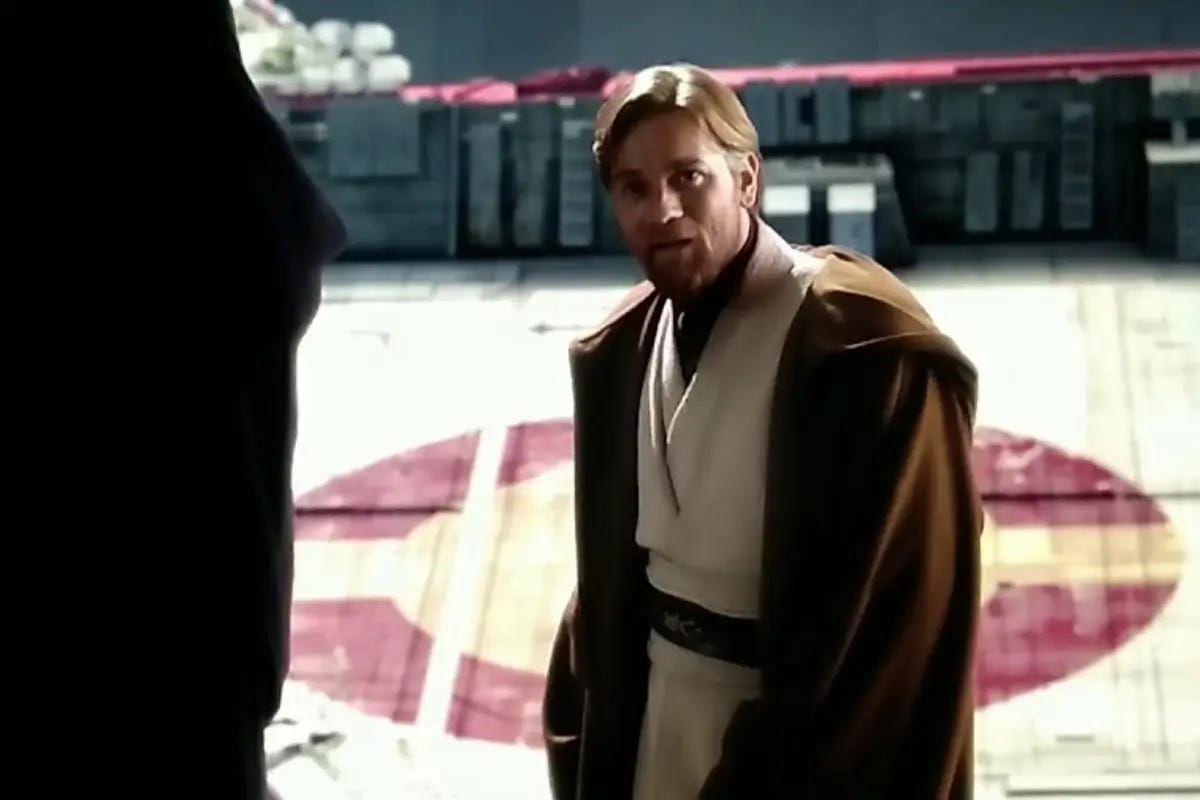
The lighting mirrors a key element in Obi-Wan’s and Anakin’s costuming. While every other Jedi wears tan and brown, ever since his first scene in Attack of the Clones, Anakin has worn darker tones. It can be easy to overlook since it’s so consistent (and admittedly a sharp look), but the palette clearly hints at Anakin’s fall to the dark side.
In this scene, the combination of lighting, framing, and costuming makes the strongest foreshadowing statement yet. As the two Jedi walk down the corridor, Obi-Wan’s traditional Jedi robes make it look almost as if he’s radiating light.
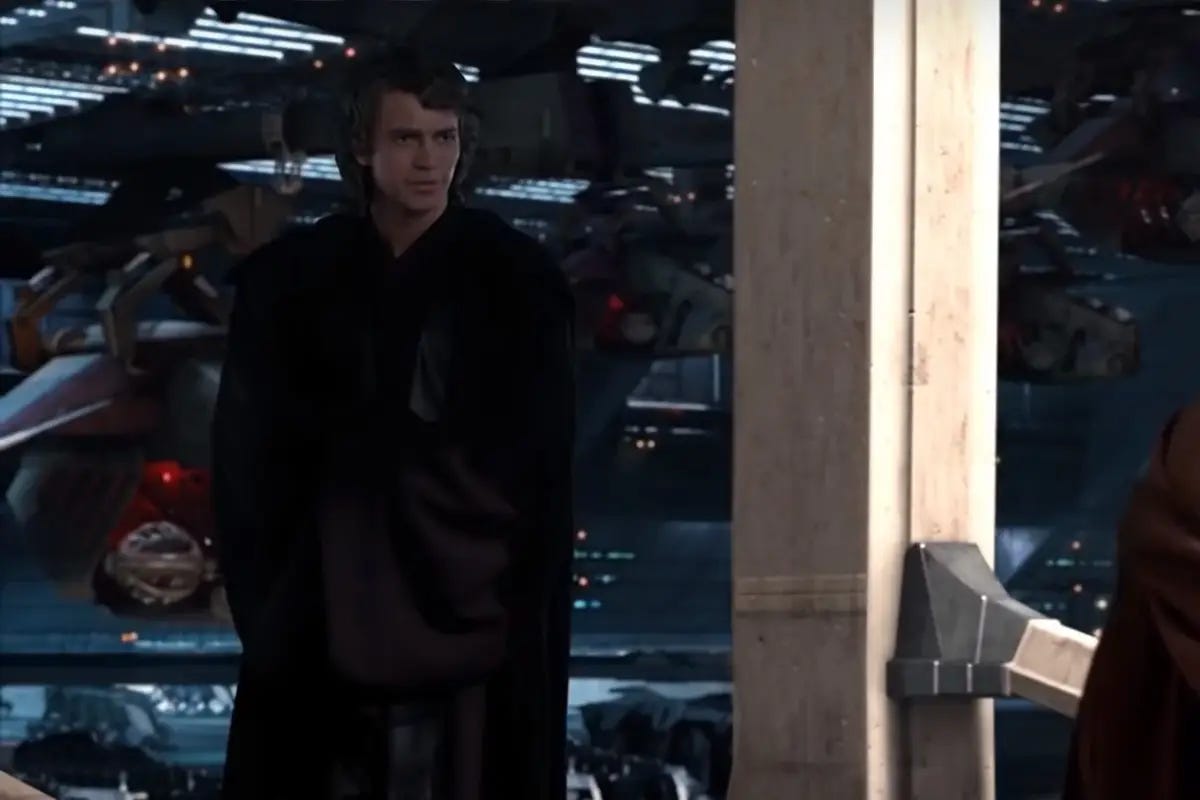
Meanwhile, Anakin doesn’t just appear to be in the shadows — his darker robes make it look like he’s of the shadows.
Dialogue
Beyond the visual storytelling, the dialogue as Obi-Wan heads off to face General Grievous also offers a bit of foreshadowing, reinforcing that this is no ordinary parting.
Of course, if you watched the movies as they came out, then even on your first viewing of Revenge of the Sith, you have an idea what’s coming. You know how Anakin ends up. Further, George Lucas knows we know. A farewell that might otherwise seem a bit grandiose makes sense in that context.
But as a thought experiment, imagine that at this point you’ve only seen the first two prequels and have somehow managed to avoid learning of Anakin’s fate. Earlier in the scene, Lucas sets up that chasing down Grievous is no simple errand. Even Anakin knows it, telling Obi-Wan, “You’re gonna need me on this one, Master.”
Still, in this thought experiment, you’ve seen enough by now to presumably feel that these are two of the Jedi Order’s best, so you might expect them to part ways here with something more casual: “See you when I get back,” or something like that.
But that’s not what happens.
Kristin Baver, in Skywalker: A Family at War, tells us that “Obi-Wan found it hard to shake a sense of finality in his parting with Anakin that day … it was as if he sensed that this would be the last time he would look into his former Padawan’s eyes.”4
And so, Obi-Wan says, “Goodbye, old friend. May the Force be with you.” It sounds like the sort of thing someone might say when they didn’t know when they’d see you again.
In our thought experiment, I have to imagine that even if I have no idea what’s coming next, the line stands out and grabs my attention. Something is clearly about to go down.
One wonders if, perhaps, Obi-Wan Kenobi has a bad feeling about this.
Parting as Brothers
Anakin may well have sensed something similar. As they part, he apologizes for his arrogance and lack of appreciation for Obi-Wan’s mentorship.
Even before The Clone Wars television series and the books and comics set between the two films, we get the sense that this war has taken the two Jedi from one end of the galaxy to the other. We know they’ve been through a lot together, and it’s not hard to imagine they had few opportunities for conversations like this.
Perhaps things may have gone differently if they had. If we remember the tensions between them in Attack of the Clones, and even some of the banter from the opening act of this film, we can see how their relationship as master and Padawan has been quite strained at times.
In Stover’s adaptation, we learn that here at this moment, as they prepare to head off in separate directions, Anakin notices in his master “… a depth of feeling he had only rarely glimpsed in all their years together.”5
Baver’s account explains that “Obi-Wan was a compassionate and kind soul, but not much given to praising Anakin … His calm, detached manner did not translate into a warm, nurturing presence — he had not been the mentor and father figure Anakin had needed.”6
It’s difficult to avoid the sense that much remains unsaid between them.
Nevertheless, we get the sense in this scene that they’re parting as brothers. Indeed, later, when they reunite under much different circumstances on Mustafar, Obi-Wan exclaims, “You were my brother, Anakin! I loved you.”
Parting as brothers may be part of the problem, part of the fall of Anakin Skywalker.
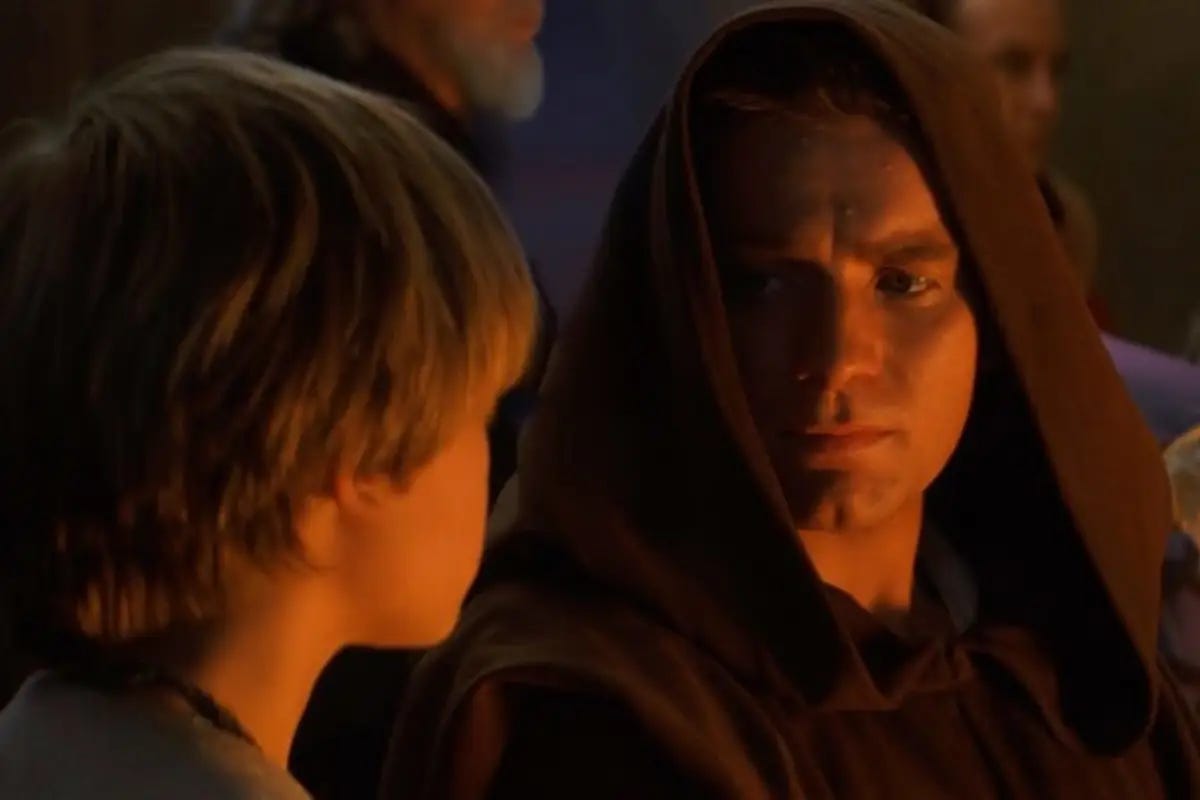
As Dave Filoni put in Disney Gallery: The Mandalorian: “Qui-Gon is … the father that Anakin needs … [Obi-Wan] is a brother to Anakin, eventually, but he’s not a father figure. That’s a failing for Anakin. He doesn’t have the family that he needs.”7
And so, when they meet again on Mustafar, they meet no longer as brothers. They meet as enemies, “just the two of them and the damage they had done to each other,” as Stover describes it.8
One fights on the side of the light. The other has fallen to the dark.
Just as their final farewell as friends told us they would.
Steve Silberman. “Life After Darth.” Wired, May 2005.
Bouzereau, L., & Duncan, J. (1999). Star Wars: The Making of Episode I, The Phantom Menace. Del Rey.
Stover, M. (2025). Star Wars – Episode III: Revenge of the Sith Deluxe Edition. Random House Worlds.
Baver, K. (2021). Skywalker: A Family at War. Random House Worlds.
Stover.
Baver.
Disney+. (2020). Disney Gallery: The Mandalorian. Episode 2, “Legacy.”
Stover.
This is beautiful. I love your insight on this.